


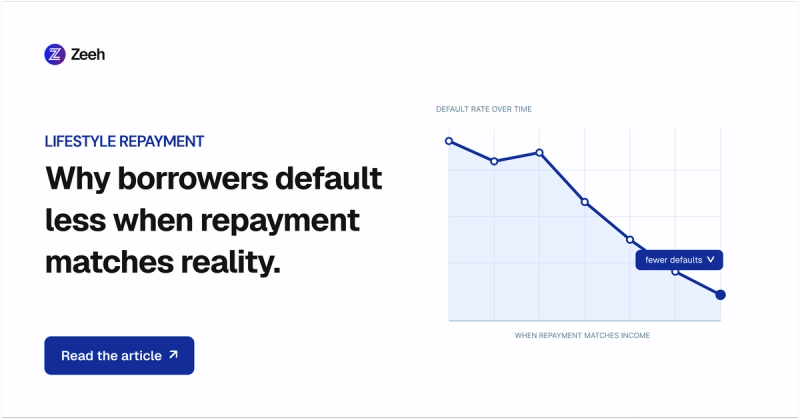
Let’s start with a question. Do you think the market trader who defaults on her loan does so because she lacks discipline? Usually, no. She does so because her repayment date falls on a Tuesday, and her income lands on a Friday, and the two have never been introduced to each other.
This is a design failure, not a moral failing. And it is one of the most expensive, avoidable, and persistently ignored problems in African lending. The conventional explanation for loan defaults in emerging markets reaches for familiar culprits: over-indebtedness, predatory interest rates, weak credit assessment, and insufficient collateral.
All of these are real. But there is a quieter failure beneath all of them, one that occurs before a single naira is disbursed, and it is the decision to impose a repayment schedule that bears no relation to how the borrower earns, spends, and manages money.
This includes fixed calendar dates applied to non-calendar income, monthly obligations structured for daily earners, and identical repayment windows for farmers who receive income twice a year and traders who receive it seven days a week.
Standard microfinance contracts, characterized by rigid weekly or monthly repayment schedules, offer little flexibility and little benefit to poor borrowers with seasonal income.
Previous research in other markets has shown that such contracts can negatively affect the economic well-being of poor borrowers, leading to underinvestment in capital, the sale of productive assets, over-indebtedness through cross-financing from informal sources, and reductions in consumption and income.
That research predates the current explosion of digital lending in Africa. What it did not predict was how great the consequences would scale when rigid repayment design met a continent of 400 million informal workers being offered credit for the first time through smartphone apps.
What Lifestyle Repayment Means
Lifestyle repayment is not a product category or a regulatory term. It is a design philosophy — the idea that a loan repayment schedule should be built around how a borrower actually earns and manages money, rather than around the lender's administrative calendar.
The name captures the core principle: repayment should fit the borrower's financial lifestyle. For example, a daily earner repays daily, a farmer repays at harvest, a merchant repays when their sales cycle closes, and a gig worker repays per job completed.
The loan obligation does not change; the amount owed remains the same, but the timing, frequency, and collection mechanism are calibrated to when the borrower realistically has money available to repay it.
This is different from standard loan repayment design in one fundamental way. Standard repayment structures are lender-centric: fixed dates, fixed amounts, fixed frequencies, chosen for operational consistency and ease of administration.
On the other hand, lifestyle repayment is borrower-centric: variable timing, potentially variable collection amounts, designed for the income pattern of the specific borrower population being served.
It is also different from loan restructuring or forbearance, which are reactive responses to a borrower already in difficulty. Lifestyle repayment is a proactive design decision made before disbursement, using verified income data to match the repayment structure to the borrower's financial reality from day one.
The goal is to make default structurally less likely by removing the most common mechanical cause of it: a repayment event landing when no income has arrived.
In practice, lifestyle repayment takes several forms depending on the borrower type:
- Daily micropayments: small automatic deductions aligned with daily income cycles, used most effectively for traders, market vendors, and gig workers who earn continuously in small amounts rather than in periodic lump sums.
- Per-transaction deductions: a percentage of each completed job, sale, or settlement, deducted at the moment income arrives on the platform. Used by logistics and ride-hailing platforms to collect from drivers without imposing a fixed date obligation on income that varies from day to day.
- Harvest-aligned repayment: repayment triggered by the arrival of seasonal income rather than a calendar date. Used in agritech and agricultural lending, where the borrower's entire income cycle is structured around planting and harvest periods that no standard monthly schedule can meaningfully accommodate.
- Sales-cycle collection: direct debit mandates tied to a merchant's verified post-sales settlement window, confirmed through Open Banking transaction data. The collection attempts occur when the data indicates the merchant's account balance is consistent with having received sales proceeds, rather than on a fixed date regardless of the balance.
What all of these have in common is that they require two things that standard repayment design does not: knowledge of the borrower's income timing, and the technical infrastructure to collect against income events rather than calendar dates.
The first comes from verified transaction data. Meanwhile, the second comes from consent-based automated collection, built to execute in response to dynamic triggers rather than fixed schedules.
Neither of these was practically available at scale in African markets until recently. Open Banking infrastructure, real-time bank transaction data with consented access, and API-driven direct debit mandates have changed that, which is why lifestyle repayment has moved from a theoretical design principle to an operationally achievable product strategy for any lender willing to build for it.
The Default Problem Has a Design Problem Inside It
Nigeria's digital lending industry, valued at an estimated $2.1 billion, is facing a reckoning with defaults. The CBN's Q2 2025 Credit Conditions Survey reported higher default rates for both secured and unsecured lending.
The standard exclamation point for Nigeria's economic conditions: inflation above 22%, shrinking disposable incomes, and a cost-of-living crisis that has pushed millions of households into a survival-borrowing cycle where one loan pays for another.
These economic pressures are real, and they contribute to defaults. But the same economic conditions do not produce the same default rates across every lender.
Moniepoint disbursed more than ₦1 trillion ($721.2 million) in credit in 2025, relying on transaction histories to assess risk and maintain low default rates, in the same market, at the same time, serving the same informal economy that other lenders are watching deteriorate into high default rates.
The difference between lenders with manageable default rates and those watching their portfolios deteriorate is rarely the credit assessment model alone. It is frequently the repayment model, specifically whether the repayment schedule was designed around how the borrower actually earns, or imposed as a default because that is how repayment has always been structured.
Direct debits are helping, though some borrowers sidestep them by moving funds to wallets like OPay, PalmPay, or Moniepoint, which continues to create ways for defaults to entrench. This is not a failure of direct debit as a mechanism; it is a failure of timing.
When direct debit attempts occur at the wrong point in a borrower's cash flow cycle, the funds are not available, causing the debit to fail. In addition, the borrower transfers funds to a wallet to protect them; as a result, the transfer is recorded as a default. And a borrower who genuinely intended to repay becomes a default statistic because nobody designed the collection around when they actually have money.
What the Research Shows
The academic literature on repayment flexibility and default rates is more definitive than most lenders seem to realize.
A field experiment published in the Review of Economic Studies found that flexible repayment contracts led to substantial improvements in borrowers' business outcomes, significant impacts on socio-economic status, and lower default rates.
Furthermore, repayment flexibility attracted less risk-averse borrowers interested in business expansion, and the effects were driven by an increase in entrepreneurial risk taking, implying that the primary mechanism is that flexibility functions as an insurance provision, not a concession to the undisciplined.
The last point deserves emphasis: repayment flexibility does not attract worse borrowers. It attracts more ambitious people, those genuinely trying to grow their businesses rather than just survive their loan terms.
The assumption embedded in rigid repayment schedules is that structure enforces discipline. However, the evidence suggests the opposite: a structure that mismatches income reality enforces default, while one that aligns with income reality enforces repayment.
A randomized control trial with microfinance clients found that clients repaying monthly rather than weekly were 51% less likely to report feeling worried, tense, or anxious about repaying, were 54% more likely to feel confident about repaying, and reported higher business investment and income.
The flexibility encouraged them to invest their loans more profitably, thereby reducing financial stress and improving repayment outcomes.
This is the counterintuitive finding that should be reshaping how African lenders design products: financial stress from poorly designed repayment schedules does not just hurt borrowers. It actively undermines repayment by diverting cognitive and financial resources away from the business activity that generates the income to repay in the first place.
Furthermore, a study of micro- and small-scale enterprises in Ethiopia explicitly found that lending institutions should align repayment schedules with enterprises' production periods, not as a courtesy to borrowers, but as the most practical way to improve repayment performance. This finding holds across geographies and across borrower types, from Indian microfinance clients to Ethiopian SMEs to Nigerian informal traders.
The African Earning Cycle That Standard Repayment Ignores
Understanding why this matters so acutely in African markets requires recognizing the specific ways African borrowers earn, which are almost entirely unlike the model on which standard loan repayment was designed.
In Nigeria, over 60% of the workforce operates in the informal economy. Gig workers might earn from multiple platforms simultaneously — trading on weekdays, riding on weekends, freelancing monthly. Similarly, SMEs have complex cash flows with seasonal variations, irregular client payments, and business investment cycles. None of these income patterns map cleanly onto a fixed monthly repayment date.
Moniepoint's Informal Economy Report 2025 reveals that informal merchants pay wholesalers by bank transfer but collect cash from customers, creating a two-loop payment system in which the timing of money moving in and out varies by transaction type.
A repayment collection that attempts to withdraw funds at the wrong point in either loop fails, not because the merchant does not have money overall, but because the money is in the wrong place at the wrong time.
For example, a market trader may earn small amounts daily, a ride-hailing driver earns per completed job, and an artisan in Aba earns when a client pays, which doesn't follow any calendar logic at all.
A borrower who misses one repayment deadline borrows from a second app to pay the first. Late fees and compounding interest turn small amounts into unmanageable burdens. Many juggle three or more platforms simultaneously, a spiral that worsens amid Nigeria's cost-of-living crisis.
The spiral begins with the first missed payment. The first missed payment usually occurs when a repayment date falls at the wrong point in the borrower's earnings cycle. The design failure compounds into the debt trap.
The Model That Proved Lifestyle Repayment Works at Scale
The most compelling evidence for income-aligned repayment design in the African market does not come from an academic paper. It is M-KOPA Nigeria's 2025 Impact Report.
M-KOPA has unlocked over ₦230 billion in credit for more than one million customers in Nigeria, making Nigeria its fastest-growing market globally since its 2019 launch. The company's target population, the everyday earners, is traders, drivers, artisans, and small shop owners who earn and spend in daily cycles.
These are precisely the borrowers that traditional lenders decline and that poorly designed digital lending products turn into default statistics.
M-KOPA's model allows customers to make an initial deposit followed by daily payments. Not monthly payments or fixed-date collections. Daily micropayments that align with the earning rhythm of the people repaying them.
The daily payment model works for everyday earners because everyday earners earn every day. The repayment structure was designed around the borrower's reality rather than the lender's administrative convenience.
By aligning daily repayments with the everyday earner's cash flow and removing the need for collateral, M-KOPA has effectively bypassed the credit-score barrier that stymies traditional Nigerian banks.
77% of M-KOPA's customers use their smartphones or digital loans to generate income. Three in four say they are earning more since joining the platform. The repayment design did not just reduce defaults. It enabled the business growth that makes repayment sustainable over time, confirming the academic finding that flexible, income-aligned repayment structures improve both borrower outcomes and lender portfolio quality simultaneously.
The Infrastructure That Makes Lifestyle Repayment Possible
Designing repayment around a borrower's income cycle requires two things that most lenders historically lacked: verified knowledge of when and how the borrower earns, and the technical infrastructure to collect at the right moment rather than on a fixed date. Both are now available with Zeeh.
Zeeh Connect provides open banking-powered access to verified bank transaction data with explicit borrower consent, pulling income patterns, timing of inflows, spending behavior, and cash flow cycles directly from the bank account.
For a lender designing a repayment schedule, this data answers the fundamental question that standard loan contracts never ask: when does this specific borrower actually have money?
Income categorization from Connect shows not just how much a borrower earns but the timing pattern of those earnings, whether daily, weekly, irregular, or seasonal. This gives the lender the specific data needed to design a repayment schedule that aligns with reality rather than assumption.
Zeeh Insights converts that raw transaction data into structured credit intelligence, including cash flow stability scores and affordability calculations that identify not just the maximum amount a borrower can repay, but the timing windows within their earning cycle when collection has the highest probability of success.
For lenders moving from fixed-date to income-aligned collection, this is the analytical layer that makes that shift precise rather than approximate.
Zeeh Direct Debit provides the consent-based, automated collection infrastructure that executes repayments at the right time. Rather than a fixed calendar, collection mandates can be structured around verified income events — market settlement dates, platform earnings disbursements, salary payment dates, harvest proceeds arrivals.
The mandate is set at the time of disbursement with the borrower's explicit consent. As a result, the lender's operational costs drop to near zero, and the collection failure rate drops with them because the attempt is no longer racing against an empty account.
Together, these three products give lenders the complete infrastructure chain for lifestyle repayment: the income timing data, the credit intelligence to calibrate repayment amounts and windows, and the collection mechanism to execute against verified income events rather than arbitrary calendar dates.
For a broader look at how this infrastructure fits into the embedded finance landscape across Africa, our analysis covers the full ecosystem context, and our piece on why embedded lending fails and how African platforms can get it right goes deeper into the specific failure patterns this approach addresses.
The Competitive Argument for Getting This Right
There is a business case for lifestyle repayment that goes beyond lower default rates, and it is worth making explicitly.
A lender whose repayment model works with borrowers rather than against them builds something extremely difficult to replicate: a loan product borrowers trust enough to take again.
Nigeria now has about 505 approved digital lenders as of 2026, up from 173 in April 2023. In a crowded market, the lenders who retain borrowers across multiple loan cycles are the ones who build the data depth and customer relationships that compound into a real competitive advantage.
A borrower who repaid successfully on an income-aligned schedule has a richer financial history on that lender's platform than one who defaulted and recovered. That history is the input to the next underwriting decision, the next credit limit, and the next product offering.
Flexible repayment schedules can be introduced sustainably to promote entrepreneurship among micro and small enterprises without negatively affecting repayment rates, which means the product that reduces default also expands the addressable market by making credit viable for borrowers that rigid schedules would have turned into one-time defaulters.
The lenders building this way in 2025 and 2026 will not just have better portfolios. They will have borrower relationships, repayment track records, and financial behavior data that make their credit products genuinely difficult to displace once borrowers are using them.
Bottom Line
The default problem in African digital lending has been treated for too long as a credit assessment problem, a question of who to lend to rather than how to structure what you lend. Better underwriting is necessary, likewise better data.
However, neither solves the problem that arises when a well-assessed borrower, with genuine repayment intent and sufficient income, defaults because the repayment date and the income arrival date have never been reconciled.
MFI clients are almost always poor, with irregular income throughout the year, which frequently results in a cash-flow disconnect when a repayment is due. Sometimes clients resort to selling productive assets, labor, or crops in advance, underinvesting, or skipping meals and reducing consumption, only to borrow from local moneylenders at very high interest rates to repay MFI loan installments.
That last sentence is the one that should bother every lender operating in African markets. The person who took your loan to improve their financial situation is now selling assets, skipping meals, and borrowing from informal lenders at 30% monthly interest in order to repay you on the date you chose for your administrative convenience.
Repayment design is a product decision. It is as consequential as interest rate, loan size, and eligibility criteria. And the lenders who design it around the actual cash flow patterns of their borrowers will find that default is not an inevitable cost of lending in Africa. It is, in many cases, a design problem with a design solution.
Talk to the Zeeh team about building income-aligned repayment infrastructure for your lending product.



