


Credit unions built their entire identity around the people the big banks did not serve well. The member-first model, the community branch, and the willingness to underwrite someone a major bank would decline are not accidents.
They are the strategic reason credit unions exist. And right now, a combination of Canada's new Consumer-Driven Banking Act and the fastest-growing newcomer demographic in the country's history is presenting credit unions with either their biggest opportunity in a generation or a competitive gap they cannot afford to leave open.
The question of which it becomes depends almost entirely on whether credit unions treat the CDBA as a compliance issue or a growth one. The law does not force them to participate. But the market, specifically the African immigrant market that has shifted Canada's immigration scene significantly in the last three years, will not wait for institutions that choose to sit it out.
Let’s explore what Canada’s open banking framework means for credit unions.
What the CDBA requires of credit unions
The Consumer-Driven Banking Act, which received Royal Assent through Bill C-15, mandates participation from Canada's large federally regulated banks, also known as the Big Six. However, credit unions are not on that list.
Participation for provincially regulated financial institutions, including credit unions and Crown corporations, is voluntary under an opt-in model.
That is the first thing credit union leadership needs to understand clearly: only specified large banks, those above a retail volume threshold set by the Minister of Finance, are required to join the framework.
On the other hand, credit unions choose whether to participate, when, and at what level. The new legislation allows the Minister to designate a provincial regulator to oversee certain provisions, including security, privacy, liability, and complaints for entities within its jurisdiction. This means credit unions that do opt in will not necessarily be supervised directly by the Bank of Canada. A lighter provincial pathway exists for them.
The proposed Consumer-Driven Banking Regulations provide more operational detail. Credit unions participate on an opt-in basis, and those that join apply under a lighter accreditation pathway.
That lighter pathway matters because the compliance cost of participating — API infrastructure, consent management, security standards, accreditation documentation — is the most common reason smaller institutions hesitate. Thankfully, the regulatory design has tried to reduce that barrier for credit unions specifically.
The UK experience, which ran a similar voluntary-then-mandatory model starting with its CMA9, offers a useful preview. In the UK, almost every other significant financial institution followed voluntarily, not because they were forced to, but because they had to.
The competitive pressure of being outside a framework that members increasingly expect drives participation faster than any mandate. Canada is likely to follow the same pattern, and credit unions that wait for that pressure to become acute will be playing catch-up against competitors who built the infrastructure two years earlier.
The member base credit unions are already serving and losing
Credit unions serve a disproportionate share of Canada's newcomer populations. Many first-generation immigrants choose credit unions for their first Canadian banking relationship precisely because of their community roots and more flexible onboarding approaches compared to the Big Six.
Credit unions should not overlook the ongoing potential that immigrant communities, including newcomers, established immigrants, and their children, continue to represent. Even with lower federal targets, these communities remain among the fastest-growing consumer segments in Canada, contributing significantly to the country's younger population.
The demographic context for this is important. Immigrants make up about 23% of Canada's population and are expected to reach nearly one-third by 2041. Plus, immigration drives a large part of Canada's population growth, and immigrants own about 32% of businesses.
For credit unions whose existing member base is aging, this is not an abstract inclusion consideration, but a sustainability question. As the member base of many credit unions continues to age, attracting younger, diverse members will be essential for long-term sustainability. However, credit unions have historically struggled to engage immigrant communities as effectively as the Big Five banks.
Credit unions have the community positioning and the member-service philosophy that should make them the natural first choice for newcomers. However, the product infrastructure, particularly around credit decisioning for thin-file members, has often lagged behind the Big Six, which have the technology budgets to build newcomer-specific programs and the institutional partnerships to verify foreign credit histories.
This is shown in Scotiabank partnering with Nova Credit, TD building a dedicated newcomer content and banking program with CanadaVisa, and RBC having a long-running newcomer banking program. The Big Six are not conceding this segment.
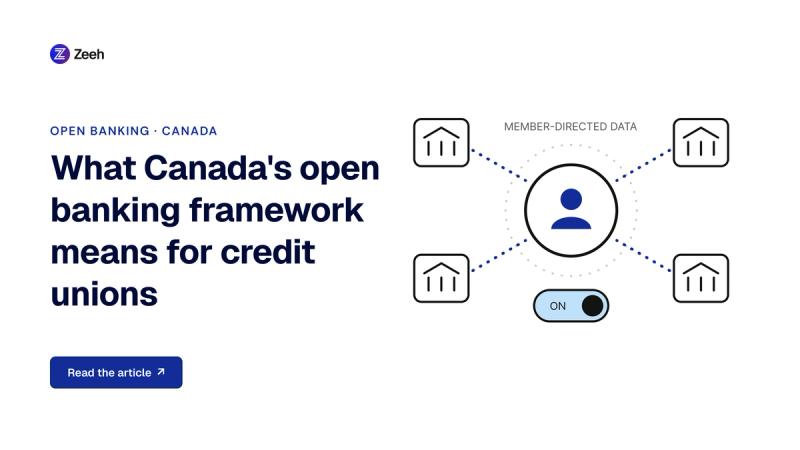
Open banking, if credit unions use it correctly, creates an opportunity for them to compete differently through better data access and digital member experiences. A credit union that is accredited under the CDBA framework can offer members the same consented, API-based data sharing that the Big Six are building toward.
In some cases, it can do it with more personalized service and fewer switching costs, because the member relationship at a credit union is genuinely closer than at a national bank.
What Phase 1 enables for credit union newcomer lending
Phase 1 enables read-only access: sharing financial data with accredited providers. With the customer's consent, accredited providers can access data from deposit, investment, credit, and payment accounts.
For credit unions, the practical application of this in newcomer lending is direct. It means that Phase 1 opens a compliant, governed channel to retrieve a member's transaction history and use it for underwriting purposes, replacing the combination of manual document review and screen-scraped data that many credit unions currently rely on.
For members who have been in Canada for 12 months or more and have built up meaningful Canadian banking history, this is immediately useful. A credit union can run a cash flow underwriting assessment on the same API connection that Phase 1 enables, without asking the member to print out statements or submit payroll documentation. The consent is digital, the data is structured, and the decision is faster.
This matters for newcomer credit decisions specifically because the thin-file problem is partly about time, when most newcomers simply haven't had long enough to build a Canadian credit file that a standard bureau check finds meaningful.
Transaction data from the first 12 to 18 months of Canadian banking fills part of that gap, giving a credit union's underwriting model something to work with while the bureau file grows.
However, what Phase 1 does not resolve is the cross-border data problem. For example, a member who arrived from Nigeria or Cameroon six months ago has at most six months of Canadian transaction data.
Their bureau file in Canada is either absent or a single secured credit card, and their ten-year repayment history with a formal bank in Lagos or Yaoundé is not accessible through any Canadian open banking connection.
This means that many newcomers will arrive with credit histories that often go unseen by Canadian financial institutions. Phase 1 does not change that. It gives lenders better access to Canadian data, not African data.
The credit union case for opting in now
The proposed CDBA Regulations are in their 60-day consultation window. That window closes August 26, 2026, and it is the moment for credit unions to engage with the accreditation pathway and begin assessing what participation requires from their systems.
The opt-in model creates a first-mover advantage that is specific to credit unions. Large banks are mandated—their compliance is not a strategic decision, but a legal one. For credit unions, opting in early signals something different to members and to the fintech ecosystem.
It shows that this institution is building data infrastructure, taking consent-based data sharing seriously, and positioning itself as a platform rather than a legacy provider. That positioning matters to the younger, diverse membership base credit unions are trying to attract.
One commentator noted that the streamlined accreditation process will help with adoption and avoid the situation experienced in countries like Australia where adoption was slow due to the large compliance burden in accreditation processes.
The lighter pathway for credit unions is a genuine advantage if they use it. Waiting to see how the Big Six handle implementation and then following their model two years later is not a strategy, but a concession of the ground where credit unions should be competing hardest.
How Zeeh works alongside the CDBA for African newcomer members
For credit unions that serve African newcomer populations or want to, the CDBA's Phase 1 is one layer of a fuller infrastructure picture, not the complete answer.
The cross-border gap that Phase 1 leaves open for members arriving from African countries requires a separate data layer built specifically for African financial data that connects directly to Canadian underwriting workflows.
Zeeh comes into play with our product stack, starting with the ZeehID. This verifies the identity of African newcomers at the document and government database level with biometric matching and sanctions screening embedded in the same pipeline.
For a credit union whose loan officer is reviewing a new membership application from a Cameroonian engineer or a Nigerian business owner, ZeehID resolves the identity verification step that many KYC systems cannot handle for these document types, in a flow that the credit union's existing onboarding process can accommodate without a full system rebuild.
Moving on, the Credit History feature retrieves that member's bureau data from CRC and FirstCentral in Nigeria, Metropol in Kenya, XDS in Ghana, and equivalent sources across other African countries, normalizing it into the tradeline formats and score equivalents that a credit union's underwriting model can apply directly.
The consent architecture is built to meet both the CDBA's express consent requirements and the data protection frameworks of the source countries involved, because cross-border compliance is only real when it covers both sides of the data transfer.
Lastly, Insights adds the cash flow layer—open banking transaction data, income patterns, account stability—that either supplements the foreign bureau data or fills the gap for members whose formal bureau record is thin.
For a credit union working toward Phase 1 accreditation under the CDBA, Insights is the same cash flow analysis the CDBA enables for domestic members, extended to cover African newcomers whose most valuable financial data sits outside the Canadian open banking ecosystem.
Together, these three products give a credit union's loan officer a complete member profile — verified identity, a longitudinal repayment history from the home country, and current Canadian financial behavior — through an integration that does not require the credit union to rebuild its core banking system around it.
Bottom Line
The WOCCU's 2024 study on financial inclusion for migrants and refugees found that credit unions serving migrant populations consistently outperform on member loyalty and long-term retention because members remember being well-served during a financially vulnerable period.
Metro Credit Union, which serves large migrant populations across 14 of its 18 branches, structured its workforce to be representative of the communities it serves—14 of those 18 branch managers are immigrants, either first or second generation. That is not a coincidence, but a strategic decision about which market to serve well.
Canada's open banking framework gives credit unions a standardized framework to compete more effectively using customer-permissioned financial data. The opt-in structure gives them a choice about when and how to enter.
The African newcomer segment gives them a specific, growing, underserved population where the combination of community positioning and better data infrastructure could close a gap; a challenge that remains unresolved across much of the industry.
The credit unions that opt in early, build their accreditation infrastructure now, and pair the CDBA's domestic data access with cross-border verification for their African newcomer members will not just comply with a framework. They will own a customer relationship that starts on arrival and compounds over the full financial life of a member who was well-served when they needed it most.
Zeeh provides credit unions and community lenders with verified identity, cross-border credit history, and cash flow analysis for African newcomer members, through an integration that works alongside the CDBA framework. ZeehID, Credit History, and Insights give your underwriting team the complete data picture from day one.
If you’d like to explore how, book a demo with our sales team.



