


Africa’s digital finance revolution has unlocked opportunity at an unprecedented scale, but it’s also opened a new frontier for fraud. In Nigeria, banks and fintechs lost ₦52.26 billion to fraud in 2024, per the NIBSS Fraud Report. What makes that figure striking isn’t just its size; it’s the pattern behind it.
There were fewer fraud cases than in 2020, yet losses soared by almost 200%. This shift reveals a new reality: today’s fraud isn’t random or opportunistic. It’s organized, calculated, and fueled by the same technology that powers modern finance.
As payments surge across borders and platforms, the tools of innovation are being mirrored by tools of exploitation.
This shift is not just changing how criminals steal. It is fundamentally testing whether Africa's digital finance boom can survive the security crisis growing within it.
The Numbers Tell a Disturbing Story
The scale of fraud across African digital finance has moved beyond isolated incidents into systematic patterns that demand attention.
According to INTERPOL's 2025 Africa Cyberthreat Assessment Report, two-thirds of African member countries now report that cyber-related crimes account for a medium-to-high share of all crimes, rising to 30% in Western and Eastern Africa. This is not a distant threat. It is the current reality.
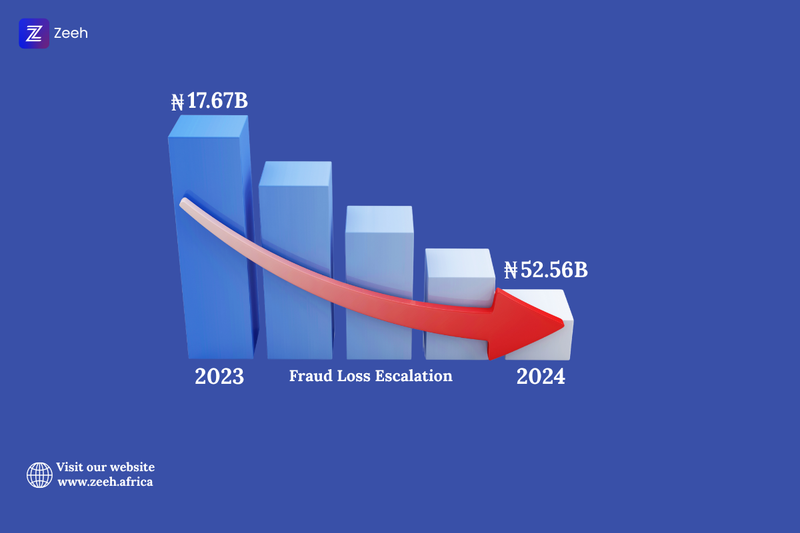
The financial impact is staggering. Nigeria alone saw fraud losses jump from ₦17.67 billion in 2023 to ₦52.26 billion in 2024, a ₦34.59 billion increase in just one year, according to NIBSS data.
Put differently, while the ratio of fraud value to total transaction value declined from 0.0053% in 2020 to 0.0022% in 2023, it spiked back to 0.0040% in 2024, suggesting that fraud is accelerating faster than transaction growth.
Across the continent, the picture is similarly concerning. Africa now ranks as the most fraud-exposed region globally, with an average score of 3.84 on the Sumsub 2025 Global Fraud Index, significantly higher than the global average of 2.79.
Within Africa, Nigeria ranks 110th globally in fraud protection, alongside Tanzania (108), Uganda (107), Rwanda (105), and Ethiopia (102) among the least protected countries worldwide. However, these aggregate numbers obscure the human cost.
Between June and August 2025 alone, INTERPOL's Operation Serengeti 2.0 identified nearly 88,000 victims across 18 African countries, with losses totaling $97.4 million recovered from just the cases they managed to trace.
The trend is clear: fraud is not just keeping pace with digital finance growth; in many metrics, it is outrunning it.
The Evolution: From 419 Scams to AI-Powered Fraud
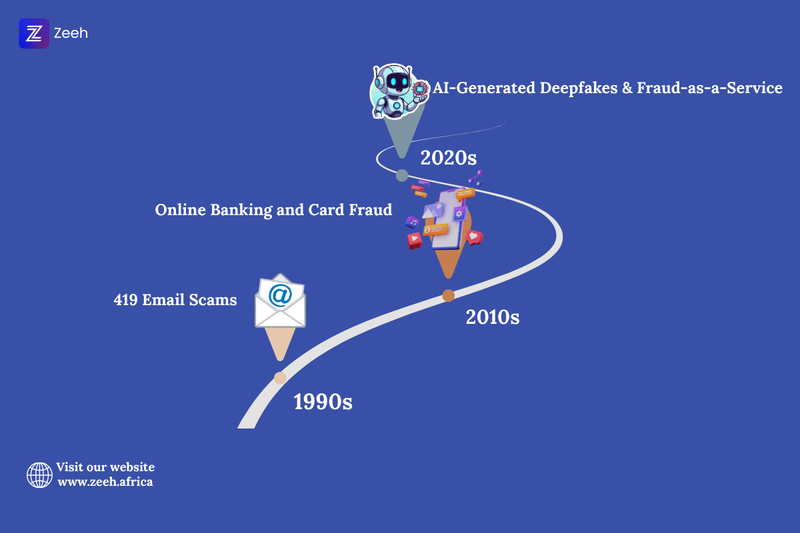
Nigeria's fraud landscape has undergone a dramatic transformation, moving from the crude email scams of the 1990s to sophisticated, technology-enabled operations that rival legitimate fintech in their complexity.
The Old Playbook No Longer Works
The infamous "419" advance fee fraud that put Nigerian cybercrime on the global map was relatively simple: mass emails promising wealth in exchange for upfront payments. These schemes relied on volume over sophistication, casting wide nets and hoping for a few bites.
Today's fraud operations bear little resemblance to those crude beginnings. According to Smile ID's 2025 Digital Identity Fraud in Africa Report, which analyzed over 110 million identity verification checks across Central, East, West, and Southern Africa in 2024, fraudsters are now deploying Generative AI, deepfakes, and insider-assisted schemes at scale.
The Rise of Fraud-as-a-Service
Perhaps the most concerning development is the emergence of what security experts call "Fraud-as-a-Service" (FaaS), a business model where cybercriminals offer fraud tools and services to other fraudsters, democratizing sophisticated fraud capabilities.
As Corradino Corradi, General Manager of Information Security at MTN, explained to Sumsub: "Fraud-as-a-Service is a business model where cybercriminals offer fraud tools and services to other fraudsters and criminals, enabling them to commit various types of fraud without needing advanced technical skills."
This industrialization of fraud means that operators no longer need deep technical expertise. They can rent malware, buy stolen credentials, and access sophisticated attack tools through underground marketplaces, significantly lowering the barrier to entry for would-be fraudsters.
AI: The New Frontline
Generative AI has fundamentally shifted the fraud landscape. Kenya's National Computer Incident Response Team (KE-CIRT/CC) reported a sharp increase in AI-generated phishing attacks and deepfake scams in early 2025. During the first quarter alone, Kenya detected 2.5 billion cyber threat events, a staggering 201.85% increase from the previous period.
AI enables fraudsters to create highly convincing phishing emails, generate fake identity documents that pass initial verification, produce deepfake videos for social engineering attacks, and automate account takeover attempts at unprecedented scale.
Smile ID's report notes that while biometric verification adoption has strengthened fraud prevention overall, fraudsters are responding with increasingly sophisticated deepfakes and synthetic identity creation tools powered by AI.
High-Profile Cases: When the System Fails
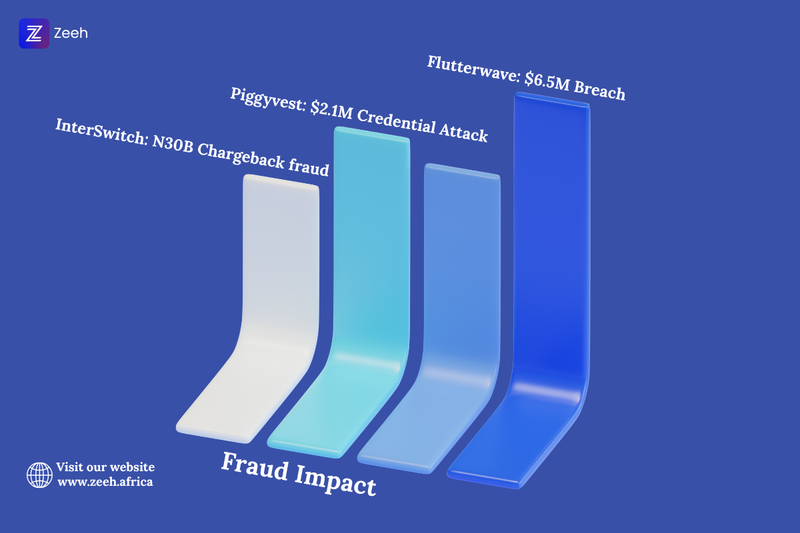
The abstract statistics gain concrete meaning when examining specific incidents that have shaken confidence in Africa's digital finance ecosystem.
Flutterwave's $6.5 Million Breach
In 2023-2024, Flutterwave, one of Africa's fintech unicorns valued at $3 billion, suffered a major breach involving unauthorized transactions exceeding $6.5 million. The incident triggered civil suits and regulatory scrutiny in both Nigeria and Kenya, raising serious questions about security protocols at even the most established players.
PiggyVest's Wallet Attack
In 2024, PiggyVest experienced a credential stuffing attack that compromised user wallets, resulting in over $2.1 million in losses. The attack exploited weak password practices and a lack of multi-factor authentication, exposing vulnerabilities in how digital savings platforms protect customer funds.
Interswitch's ₦30 Billion Loss
Also in 2023, Interswitch reportedly incurred ₦30 billion in losses through fraudulent chargebacks, revealing systematic weaknesses in transaction dispute resolution mechanisms that fraudsters have learned to exploit.
First Bank's Insider Fraud
Perhaps most disturbing was the 2023 First Bank of Nigeria insider fraud case, where an employee-led ring siphoned ₦40 billion by creating proxy accounts and routing funds through shadow beneficiaries.
This case highlighted how insider threats, employees with legitimate system access who turn criminal, represent some of the most dangerous vulnerabilities.
OPay's Phishing Wave
From 2024 to 2025, more than 5,000 OPay accounts were compromised through phishing and SIM swap fraud, demonstrating how mobile money platforms, critical infrastructure for financial inclusion, remain vulnerable to relatively unsophisticated social engineering attacks.
These cases share common patterns: sophisticated technical execution, exploitation of system vulnerabilities, and significant reputational damage that extends far beyond immediate financial losses.
The Trust Crisis
The accumulation of high-profile fraud cases is creating a secondary crisis that may prove more damaging than the direct financial losses: an erosion of trust in digital financial services.
According to data cited by the Chartered Institute of Forensics and Certified Fraud Investigators of Nigeria (CIFCFIN), 40% of fintech users now express distrust in mobile platforms. This is a catastrophic figure for an industry built on the promise of convenient, secure digital access to financial services.
The impact extends to business operations. Many Small and Medium-sized Enterprises (SMEs) reportedly lost revenue due to fraud-related service disruptions. When businesses cannot trust digital payment systems, they revert to cash, undermining years of progress toward financial digitization.
Perhaps most concerning for Africa's fintech ecosystem, international investors are becoming more cautious, leading to slower funding for Nigerian and African startups. The connection is direct: fraud undermines the growth narrative that has attracted billions in venture capital to African fintech.
For Lagos-based trader Amaka Eze, the trust crisis is personal. She lost ₦450,000 in July through a phishing scheme. "I had just started trusting digital payments to avoid carrying cash around," she said. "Now I'm afraid to use mobile wallets." Her story is not unique; it is becoming the norm.
This erosion of trust represents an existential threat to financial inclusion goals. If people fear digital systems more than they value their convenience, adoption stalls and may even reverse.
Regional Variations: Fraud Adapts to Local Conditions
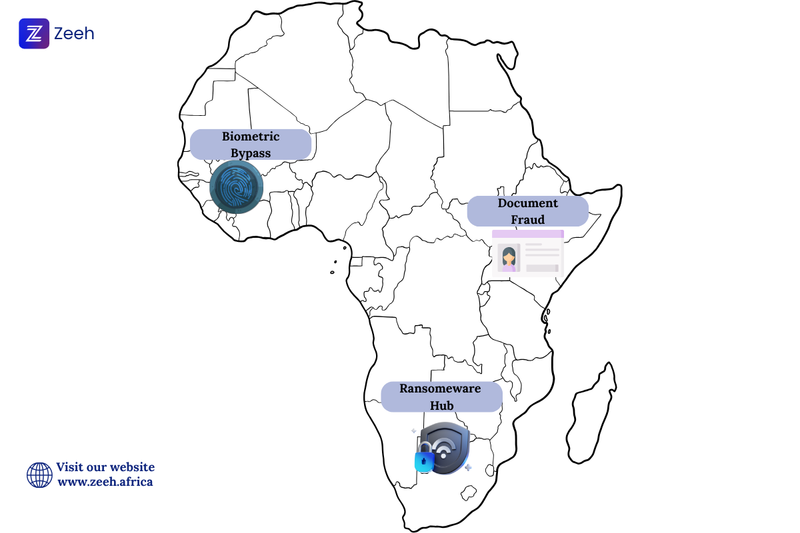
Fraud patterns across Africa are not uniform but instead show distinct regional characteristics based on local infrastructure, regulatory frameworks, and digital maturity.
East Africa: Document Fraud Dominance
According to TransUnion's 2025 H1 Africa Digital Fraud Report, East Africa experienced the highest fraud rejection rate at 27% in 2024, largely due to the prevalence of low-quality identity documents that are relatively easy to falsify.
Kenya, the region's digital finance leader, reported a fraud rate of 10.3% during peak shopping periods like Black Friday in 2024.
West Africa: Biometric Bypass
West Africa shows higher rates of biometric fraud, with criminals increasingly deploying AI-powered tools to bypass facial recognition and fingerprint systems.
Nigeria, as the region's largest digital economy, accounts for significant portions of Business Email Compromise (BEC) fraud, with 11 African nations accounting for the majority of BEC activity originating on the continent, according to INTERPOL's assessment.
Southern Africa: Ransomware Hub
South Africa has emerged as what INTERPOL labels "the cybercrime hub of Africa," with over 230 million cybersecurity incidents reported. Ransomware detections in South Africa reached 17,849 in 2024, the highest on the continent, followed by Egypt at 12,281 detections.
Cross-Border Operations
Increasingly, fraud operations span multiple countries. In Zambia, authorities dismantled a large-scale online investment fraud scheme that identified 65,000 victims who lost an estimated $300 million.
The scammers lured victims into cryptocurrency investments through extensive advertising campaigns promising high-yield returns, demonstrating how fraud syndicates operate regionally rather than being confined to single countries.
The Infrastructure Vulnerability Problem
Africa's digital finance infrastructure, built rapidly to serve growing demand, contains systemic vulnerabilities that fraudsters are exploiting systematically.
The POS Terminal Epidemic
Point-of-Sale (POS) terminals have become critical financial infrastructure across Africa, particularly in Nigeria, where 7.7 million registered POS terminals carried out 984 million transactions worth over ₦6.4 trillion in 2024, according to NIBSS data.
However, these ubiquitous devices have become fraud vectors. Some POS terminals clone card details for later unauthorized use. Others save card information that owners can access to carry out web transactions without authorization.
The Association of Mobile Money and Bank Agents in Nigeria reports that theft and fraud through POS terminals are primarily carried out by unlicensed agents operating outside regulatory oversight.
API Infrastructure Concentration Risk
A small number of API providers power huge portions of Africa's fintech ecosystem. Companies like Paystack (processing ₦1 trillion monthly as of July 2024), Mono (handling over 150 billion transactions), and OnePipe provide the backbone for thousands of businesses.
This concentration creates systemic risk. If a major infrastructure provider experiences a security breach, the ripple effects could be catastrophic across the entire ecosystem.
The embedded finance model, where financial services live inside non-financial platforms, multiplies these vulnerabilities across thousands of implementations.
Mobile Money: Double-Edged Sword
Mobile money has been transformative for financial inclusion in Africa, but it has also created new attack surfaces. According to TransUnion's research, smartphone adoption in Sub-Saharan Africa reached 55% in 2023 and is expected to hit 86% by 2030, driving e-commerce and digital finance expansion.
However, mobile fraud is rising in parallel. SIM swap fraud, where criminals transfer a victim's phone number to a new SIM card they control, has become a major attack vector, particularly for mobile money accounts that use SMS-based authentication.
What Is Not Working: The Failures of Current Approaches
Despite increasing awareness and investment, several current fraud prevention approaches are failing to keep pace with evolving threats.
Reactive vs. Proactive
Most fraud prevention remains fundamentally reactive. Systems detect fraud after it occurs rather than preventing it proactively. By the time a fraudulent transaction is flagged, money has often moved through multiple accounts and jurisdictions, making recovery difficult or impossible.
Dr. Iliyasu Gashinbaki, founder of CIFCFIN, argues that "conventional security tools are no longer enough," advocating for digital forensics to become central to cybersecurity policy.
Fragmented Responsibility
Fraud prevention efforts are fragmented across multiple stakeholders, banks, fintech companies, regulators, and law enforcement, without effective coordination.
Each entity protects its own systems but lacks visibility into broader fraud patterns or the ability to act on cross-institutional threats.
Consumer Protection Gaps
When Nigerian banks open accounts, they require customers to sign disclaimers exonerating the bank of responsibility in case of account compromise on the customer's end.
This shifts risk entirely to consumers, many of whom lack the technical sophistication to protect themselves against increasingly sophisticated attacks.
Regulatory Lag
Regulations designed for traditional banking struggle to address digital finance realities. As NIBSS notes in its fraud report, "certain regulations need thorough examination, modification, and reinforcement to reduce the potential for fraud and increase the chances of successful recovery."
What Could Work: A Path Forward
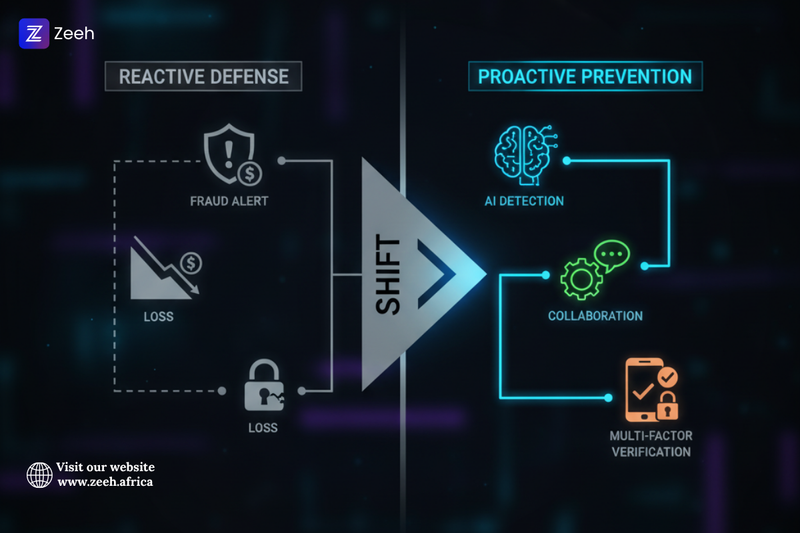
While the fraud crisis is severe, there are emerging approaches that show promise for strengthening defenses across African digital finance.
Multi-Factor, Multi-Source Verification
The most effective fraud prevention strategies rely on multiple layers of verification that make it exponentially harder for fraudsters to succeed. This means combining:
- Biometric verification (facial recognition, fingerprints) that is harder to fake than passwords
- Device intelligence that recognizes unusual access patterns
- Behavioral analytics that identify out-of-character transactions
- Network analysis that maps relationships between accounts and flags suspicious patterns
At Zeeh, we see this multi-source approach as fundamental. Relying on a single verification method, whether credit bureau data, identity documents, or even biometrics alone, creates single points of failure that sophisticated fraudsters can exploit.
Combining multiple independent verification sources creates redundancy that improves detection rates.
Real-Time Fraud Detection
Rather than batch processing and post-transaction analysis, effective fraud prevention requires real-time decision-making. This means analyzing transactions as they occur, applying risk scoring instantly, and blocking suspicious activities before they complete.
TransUnion's research emphasizes that "AI, behavioral analytics and digital identity verifications are no longer optional; they're strategic imperatives" for staying ahead of evolving fraud tactics.
Collaborative Intelligence Sharing
One of the most promising developments is increased collaboration between financial institutions, fintechs, and security providers to share fraud intelligence. When one institution detects a new fraud pattern, rapid sharing allows others to defend against it before being attacked.
INTERPOL's Operation Serengeti 2.0 demonstrated the power of this approach, bringing together investigators from 18 African countries to tackle cybercrime collaboratively, resulting in 1,209 arrests and $97.4 million in recovered funds.
Regulatory Modernization
Progressive regulators are beginning to update frameworks to address digital finance realities. The Central Bank of Nigeria recently directed all financial institutions to establish dedicated fraud desks and created the National Economic and Financial Crimes Forum (NEFF) to reduce fraud through better coordination.
However, more fundamental regulatory updates are needed, frameworks that can keep pace with technology evolution, create clear accountability for fraud losses, and enable cross-border cooperation at the speed fraud operations now move.
Consumer Education at Scale
While technology solutions are critical, human factors remain central to fraud prevention. According to Zechariah Akinpelu, CISO at Unity Bank, many losses result from customer carelessness, particularly around card security and phishing awareness.
Effective consumer education must move beyond generic warnings to specific, actionable guidance: how to recognize phishing attempts, why sharing OTPs is dangerous, how to verify app authenticity, and what to do immediately when fraud is suspected.
The Zeeh Approach: Building Fraud Resistance into Infrastructure

At Zeeh, we recognize that fraud prevention cannot be an afterthought or a separate security layer added to existing systems. It must be embedded into the foundational infrastructure that powers identity verification and financial data access.
Our approach centers on several principles learned from working with financial institutions across African markets:
- Multi-Source Verification: We integrate data from credit bureaus, banking APIs, mobile money providers, and identity databases to create verification that cannot be defeated by compromising any single source.
- Real-Time Risk Assessment: Every verification request goes through instant risk scoring that evaluates hundreds of signals, from device characteristics to behavioral patterns to network relationships, before returning results.
- Adaptive Detection: Our systems learn from fraud attempts across our entire customer base, allowing us to identify and block new fraud patterns rapidly rather than waiting for each client to be attacked independently.
- Compliance-First Design: We build regulatory compliance into our infrastructure rather than treating it as an additional requirement, ensuring that fraud prevention measures also satisfy evolving regulatory expectations.
- Transparent Operations: When we detect suspicious activity, we provide clear explanations and evidence to our clients, enabling them to make informed decisions rather than relying on opaque black-box risk scores.
The companies succeeding in fraud prevention are those recognizing that security and user experience are not opposing forces. The most effective fraud prevention is invisible to legitimate users while creating insurmountable barriers for fraudsters.
The Stakes: More Than Money
The ₦52 billion lost to fraud in Nigeria in 2024 is significant, but the full cost extends far beyond direct financial losses. There is the opportunity cost of businesses that never launch because founders fear fraud exposure.
The innovation cost of security concerns that slow product development. The inclusion cost of millions who avoid digital finance due to fraud fears. The reputational cost that affects the international perception of African fintech reliability.
As Dr. Gashinbaki notes, "This is not just a cybersecurity concern, it is a matter of national credibility, economic resilience, and digital sovereignty."
If Africa's digital finance revolution is to fulfill its promise, bringing financial services to hundreds of millions currently excluded, enabling cross-border commerce at scale, and positioning African fintech as globally competitive, the fraud crisis must be addressed with the same innovation and urgency that built the digital infrastructure itself.
The Choice Ahead

Africa's digital finance sector stands at a critical juncture. On one side is the extraordinary promise of financial inclusion, economic growth, and technological leadership. On the other hand, there is the very real risk that fraud undermines trust faster than innovation can build it.
The trajectory is not predetermined. With coordinated action, regulatory modernization, infrastructure hardening, collaborative intelligence sharing, and consumer education, the fraud crisis can be contained and reversed.
What cannot continue is the current state: industrialized fraud racing neck-and-neck with industrialized finance, with outcomes determined by which side innovates faster.
The companies, regulators, and institutions that recognize fraud prevention as a strategic imperative rather than a compliance cost will shape Africa's digital finance future. Those that don't will become cautionary tales in fraud reports.
The ₦52 billion question is not just about money lost in 2024. It is about whether Africa's digital finance boom can build the security infrastructure necessary to sustain its growth, or whether fraud will become the limiting factor that constrains what should be one of the continent's greatest economic transformation stories.



