

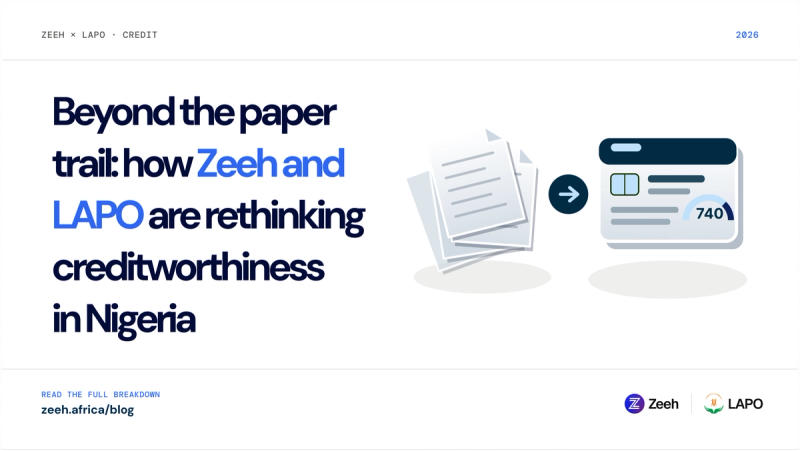
For a small business owner, proving that their business is doing well can be surprisingly difficult. A trader may have customers every day, restock regularly, and run a business that has operated for years. However, when that trader applies for formal credit, much of that activity may not appear in the records a conventional lending model is designed to assess.
This creates a difficult situation for both borrowers and lenders. The borrower may struggle to demonstrate their ability to repay, while the lender has limited information with which to make a confident decision.
This is the gap Zeeh Africa and LAPO Microfinance Bank are working to address through our partnership, using traditional financial information alongside alternative data to support a broader view of creditworthiness.
The gap is significant. Nigeria's financial inclusion rose to 74 percent in 2023, up from 68 percent in 2020, but the 26 percent who remain excluded still represent 28.8 million adults, a population any serious inclusion effort has to account for.
When the paper trail doesn't tell the whole story
Traditional credit information remains an important part of responsible lending. Bank records, previous borrowing behaviour and other formal financial information can tell lenders a great deal about a potential borrower.
The problem comes when that information is incomplete. Many traders and small businesses operate outside the structures that generate extensive formal financial records. Their economic activity can show up through daily sales, mobile transactions, supplier relationships, and other forms of business activity without translating into a conventional credit history.
A limited credit file can therefore make it hard to distinguish between someone with little financial activity and someone whose activity simply isn't captured by the traditional system.
That distinction matters. If lenders rely only on the information that is easiest to collect, they may miss businesses that are already generating income and managing their finances responsibly.
Adding more context with alternative data
Alternative data provides another way to approach the problem. Rather than relying on a single source of information, lenders can consider additional signals that help them understand a borrower's financial behaviour and capacity.
Through our work with LAPO, Zeeh combines traditional financial records with alternative data to create a fuller picture of borrowers. Depending on the use case, this can include relevant information, such as transaction history and informal business records.
The point is not to make lending decisions based on every piece of information available. Good alternative-data lending still requires discipline. The data needs to be relevant, reliable, and handled responsibly.
Furthermore, it also needs to support a genuine lending decision rather than simply creating more data for lenders to sort through. When used properly, however, alternative data can give lenders additional context that conventional credit information may not provide on its own.
Why this matters for traders and SMEs
The opportunity is particularly significant for small businesses. For instance, a large company typically has a structured financial history. It may have formal accounts, established banking relationships, documented revenue and other records that make financial assessment relatively straightforward.
However, a market trader may operate very differently. Their business can be active and profitable without producing the same volume of formal documentation. They may also have financial patterns that conventional models struggle to assess.
This gap is considerable. Nigerian MSMEs contribute over 50 percent of GDP and nearly 70 percent of employment, yet face an estimated funding gap of $236 billion, and fewer than one in 20 MSMEs currently access bank credit, a gap PwC's 2024 MSME Survey separately estimated at $32.2 billion, or roughly ₦13 trillion, in unmet financing need.
This does not mean every trader or SME should automatically qualify for credit. Responsible lending still requires lenders to understand repayment capacity and manage risk. The opportunity is to make that assessment using a more complete set of relevant information.
That distinction is important for financial inclusion. Expanding credit access should not mean lowering lending standards. It should mean improving the quality of the information used to apply those standards.
Making financial services fit the customer
Credit assessment is only one part of the problem. The way financial services are delivered also affects who can access them.
This is particularly relevant for women entrepreneurs, who can face additional barriers when formal financial services depend on processes that require extensive paperwork, physical branch visits, or unfamiliar digital experiences.
Progress here has been real but uneven. Women's financial inclusion grew from 60 percent in 2020 to 70 percent in 2023, yet the gender gap widened slightly over the same period, from eight to nine percentage points.
It's also the population LAPO has long prioritized. Women have historically made up more than 90 percent of LAPO's client base, making this partnership a natural extension of that focus rather than a new direction.
This thinking is behind Athena, Zeeh's WhatsApp-based lending product designed for women entrepreneurs. Instead of requiring customers to adopt another platform to access a financial service, Athena is being designed around a channel many customers already use.
The next phase is also being developed with multilingual access in mind, including Yoruba, Igbo, and Hausa. This would make the experience more accessible to women who are more comfortable using financial services in their preferred language.
The underlying principle is that financial inclusion involves both better assessment and better access.
What responsible alternative-data lending requires
As more lenders explore alternative data, they also need greater discipline in how they use it. More data does not automatically produce better lending decisions.
Lenders need to consider whether the information being used is accurate, relevant to credit risk, and collected with appropriate consent. They also need to think carefully about how automated decisions affect customers and whether the models being used create new forms of exclusion.
This is where the lending infrastructure becomes important. Financial institutions need systems that can bring together different sources of information, verify identity, retrieve relevant financial records, and support risk assessment without making the lending process unnecessarily complex.
That infrastructure can help lenders move from having more data to using it better.
A broader view of financial inclusion
The conversation around financial inclusion often focuses on access: how many people have bank accounts, how many people can borrow, and how many financial products are available.
However, it should also focus on how financial institutions can accurately understand the people they serve. Consider a trader with limited formal credit history who is still participating in the economy, an SME operating outside traditional structures that is still generating revenue, or a woman running a growing business who still has financial needs that deserve products built around her reality.
Better data can help bring some of that activity into view. That is the opportunity behind Zeeh's work with LAPO: combining traditional and alternative data to help support more informed credit decisions while continuing to focus on responsible lending.
Financial inclusion doesn't require lenders to ignore risk, but to understand it better. Talk to our team or book a demo to explore how Zeeh helps lenders access identity and financial data to make better-informed decisions.