


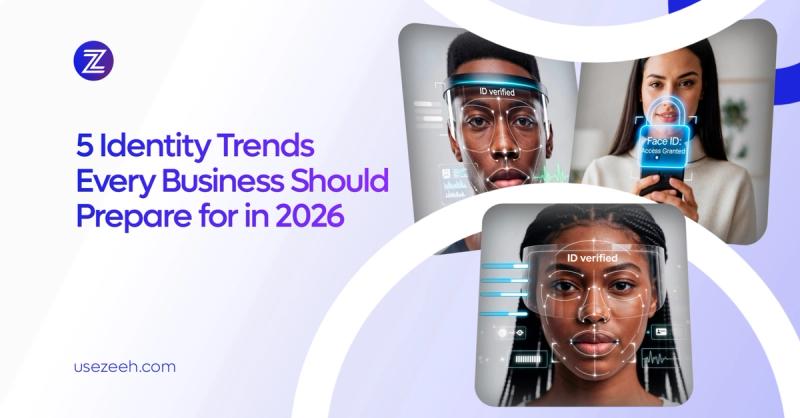
The person applying for a loan on your platform might not be a person at all. With the rise of AI and identity fraud, one can only question what is real and what isn’t, and with AI commercially available for free or for a fee, it becomes pertinent that businesses protect themselves.
Identity verification is no longer limited to people. It now extends to autonomous systems acting on their behalf: AI agents that can open accounts, submit documents, and bypass checks on their own.
Meanwhile, complete "persona kits," including synthetic faces, voices, and backstories, are sold off the shelf, and identity forgery has scaled from a skill to a service.
For Nigerian businesses building digital services, whether fintech platforms, e-commerce marketplaces, property tech companies, or any operation requiring identity verification, 2026 brings changes that will either strengthen or shatter trust in digital identity.
The businesses that understand these shifts now and adapt their verification infrastructure accordingly will thrive.
This article breaks down the five critical identity trends you must master now to reduce risk, cut operational costs, and onboard customers faster than your competitors.
Let’s get into it!
Trend 1: AI-Generated Identities Become Indistinguishable from Real Ones
The barrier to creating fake identities has collapsed. What once required specialized skills, expensive equipment, and significant time now takes minutes and costs almost nothing.
Coordinated AI attacks now involve networks of AI systems working together: one model fabricates documents, another impersonates a person in live video, and a third learns from each failed attempt.
This isn't theoretical. It's happening daily on platforms that rely on basic document checks and simple liveness detection.
For Nigerian businesses, this creates a specific challenge: the identity documents most commonly used for verification—National IDs, voter cards, driver's licenses—are precisely what AI systems have been trained to replicate.
Fraudsters aren't trying to fool human eyes anymore; they're optimizing to fool automated systems that check for specific security features and patterns.
What this means for your business
Static document verification, where an uploaded ID image is checked against a database or analyzed for authenticity markers, will become insufficient on its own.
The question shifts from "Is this document real?" to "Where did this document come from? Was it captured by a real person holding a real phone in a real environment, or was it generated by an AI system designed to look real?"
How to prepare:
Nigerian businesses need to move toward origin verification rather than just pattern matching. This means:
- Source authentication: Verify that documents come from legitimate capture devices, not AI generation tools
- Behavioral signals: Look for human behavior patterns during document submission—hesitations, corrections, natural movements that AI systems struggle to replicate consistently
- Multi-layer verification: Combine document checks with live biometric verification that includes environmental context (background consistency, lighting patterns, shadows)
- Database cross-referencing: For Nigerian verification, platforms like Zeeh that connect directly to official databases (NIMC for NIN, NIBSS for BVN) verify against authoritative sources rather than just analyzing document images
The businesses that will win in 2026 are those treating identity verification as a continuous investigation, not a one-time check.
Trend 2: Unified Verification Platforms Replace Fragmented Tools
Nigerian businesses currently juggle multiple verification tools: one for BVN checks, another for NIN verification, a third for document validation, maybe a fourth for biometric liveness detection.
Each tool operates independently, creating gaps that fraudsters exploit by passing some checks while failing others.
Organizations are now consolidating fragmented tools into unified end-to-end identity verification platforms that orchestrate document checks, biometrics, and screening under a single policy layer.
Why fragmentation fails
When verification tools don't communicate, businesses face several problems:
- Inconsistent policies: One tool might flag a customer as suspicious while another approves them, leaving your team confused about which signal to trust
- Audit nightmares: When regulators ask about a specific customer's verification, tracking decisions across multiple disconnected systems becomes impossibly complex
- Fraud exploitation: Sophisticated fraudsters test each verification component separately, identifying which ones are weakest and optimizing attacks for those specific gaps
- Operational inefficiency: Your team wastes time manually correlating data between systems, checking whether a customer who passed BVN verification also completed document upload
What this means for your business
In 2026, fragmented verification approaches create liability. When fraud occurs, regulators and customers will ask: "Did your verification systems talk to each other? Did they share signals about suspicious patterns? Or were they siloed tools that let threats slip through gaps?"
How to prepare:
Nigerian businesses need to consolidate verification into platforms that provide:
- Single orchestration layer: All verification types—document checks, database lookups (BVN, NIN, CAC), biometric liveness, behavioral analysis—coordinated under one system
- Centralized audit trails: Every verification decision logged with complete context showing which checks ran, what results returned, and how the final decision was reached
- Unified policy enforcement: Rules applied consistently across all verification types, preventing scenarios where document verification has different risk thresholds than biometric checks
- Real-time signal sharing: When one verification component detects something suspicious (odd document metadata, biometric inconsistency, database mismatch), other components adjust their sensitivity accordingly
For Nigerian platforms, this means choosing verification infrastructure like Zeeh that handles BVN, NIN, CAC, phone number validation, and document verification through integrated systems rather than duct-taping together separate vendors.
Trend 3: Machine Identity Verification Becomes Essential
Here's something most Nigerian businesses haven't considered yet: soon, many of the customers interacting with platforms won't be humans at all.
Identity is expanding beyond people to include machines, algorithms, and self-authenticating systems that act independently—the rise of machine customers capable of signing, transacting, or negotiating on their own requires new frameworks to trace every digital actor back to a responsible entity.
This isn't as futuristic as it sounds. AI assistants are already making purchases, scheduling services, and negotiating prices autonomously. In financial services, algorithmic systems open accounts, execute trades, and manage portfolios with minimal human oversight.
The line between "customer" and "automated system acting on behalf of a customer" is blurring fast.
What this means for your business
Traditional verification asks: "Is this person who they claim to be?" In 2026, businesses must also ask: "Is this interaction being conducted by a human or by an autonomous system? If it's a system, who controls it, and are they authorized to use it for this purpose?"
For Nigerian digital lenders, imagine an AI agent that applies for microloans across dozens of platforms simultaneously, each application slightly optimized based on what worked on previous platforms.
The agent isn't human, but it's operating on behalf of someone. How do you verify that the person authorizing the agent is legitimate or that the agent isn't exceeding its authority?
How to prepare:
While machine identity verification is still emerging, forward-thinking Nigerian businesses should:
- Distinguish human from machine interactions: Track behavioral patterns that signal automated versus human activity—response timing, mouse movements, form completion patterns
- Require human checkpoints for critical actions: Even if an AI assistant initiates a loan application, require verified human intervention at key decision points, especially for final approval, fund disbursement
- Verify authority chains: When systems act on behalf of humans, verify that the human has authorized those specific actions, not just general account access
- Prepare for hybrid verification: Develop systems that can verify both the machine's identity (what system is this?) and the human's authority (who controls it and authorized its actions?)
This trend is just beginning, but businesses that understand it now will adapt their verification infrastructure before it becomes an urgent problem.
Trend 4: Biometric Verification Gets Smarter and So Does Fraud
Biometric verification—facial recognition, fingerprint scanning, voice authentication—has become standard in Nigerian digital services. But 2026 brings both significant improvements in biometric technology and sophisticated attacks specifically designed to defeat it.
On the defense side, biometric systems are incorporating AI-driven liveness detection that goes far beyond asking users to blink or turn their heads.
Modern systems analyze micro-expressions, skin texture variations, environmental context, and behavioral patterns that deepfake systems struggle to replicate consistently.
On the attack side, AI-driven fraud, including synthetic identities and real-time deepfake attacks, has surged in financial services. Fraudsters aren't using static fake videos anymore.
They're generating real-time deepfakes that dynamically respond to liveness challenges, making them far harder to detect.
What this means for your business
Basic biometric checks will become inadequate. Fraudsters have trained AI models on millions of successful verification videos and can now generate synthetic faces that pass these simple tests.
The gap between sophisticated biometric verification and basic implementations is widening, and businesses stuck with basic systems will see fraud rates climb.
How to prepare:
Nigerian businesses need to upgrade biometric verification with:
- Advanced liveness detection: Systems that analyze dozens of biometric signals simultaneously, including facial micro-movements, skin texture consistency, lighting reflections, behavioral patterns, rather than relying on simple challenges
- Environmental verification: Checking that biometric capture happens in a real physical environment (consistent backgrounds, appropriate lighting, shadows that match face geometry) rather than from a screen displaying a deepfake
- Behavioral biometrics: Tracking how users interact with devices during verification—typing patterns, swipe behaviors, device handling—creating profiles harder for AI to replicate
- Continuous re-verification: The new standard involves periodic, automated re-verification to ensure the customer's data profile remains consistent and hasn't been anomalously altered, which is a potential red flag for account takeover or synthetic identity maturation
For Nigerian platforms, this means partnering with verification providers that invest heavily in AI-resistant biometric systems rather than static implementations that fraudsters can study and defeat.
Trend 5: Regional Identity Fragmentation Increases
Many businesses hoped that 2026 would bring greater standardization in digital identity, a world where verification in one country easily translates to verification in another. Instead, the opposite is happening.
According to Gartner's predictions, by 2027, around 35% of countries will be locked into region-specific AI platforms built on proprietary contextual data, leading to "digital nation-state ecosystems" where domestic data, national digital IDs, local AI models, and protectionist cloud rules combine into closed, sovereign infrastructures.
For Nigerian businesses, this trend has immediate implications. Nigeria's identity infrastructure (BVN, NIN, CAC) operates independently from Kenya's (IPRS, National ID) and South Africa's systems.
Rather than converging toward a unified African identity framework, each country is strengthening its own systems while making cross-border verification more complex.
What this means for your business
Pan-African expansion requires multiple verification integrations, not one. A platform that successfully verifies Nigerian customers cannot simply extend that same verification to Kenyan or South African customers without building entirely new integrations with different databases, different document types, and different regulatory frameworks.
For global businesses, fragmentation creates compliance bottlenecks because each region defines its own onboarding and verification rules, leading to cross-border verification failures in which an ID trusted in one country is rejected in another.
How to prepare:
Nigerian businesses planning regional expansion should:
- Build for fragmentation, not convergence: Assume identity systems will remain country-specific and plan infrastructure that can integrate with multiple independent systems
- Partner with multi-country platforms: Rather than building separate integrations for each African market, work with providers like Zeeh that have already built connections to Nigeria (BVN, NIN, CAC), Kenya (IPRS, National ID), South Africa (National ID), Ghana, Uganda, and Rwanda
- Accept increased complexity: Regional expansion means managing different verification documents, regulatory requirements, and customer expectations in each market
- Plan for ongoing divergence: Don't wait for standards to emerge. They're moving in the opposite direction as countries prioritize data sovereignty and local control
The businesses that will succeed in Pan-African expansion are those that embrace complexity and build infrastructure capable of handling dozens of distinct identity systems rather than hoping for simplification that isn't coming.
What This Means for Nigerian Businesses
These five trends aren't arriving gradually; they're converging simultaneously in 2026. AI-generated identities, unified verification platforms, machine customers, advanced biometrics, and regional fragmentation are all reshaping identity verification at once.
For Nigerian businesses, this creates both threat and opportunity:
The Threat: Businesses relying on basic verification—simple document checks, static database lookups, elementary liveness detection—will see fraud rates climb. Fraudsters are specifically targeting platforms with weak verification because those are the easiest marks.
Every day your verification infrastructure remains outdated, the gap between your defenses and attackers' capabilities widens.
The Opportunity: Businesses that invest in modern verification infrastructure now—unified platforms with direct database integration, AI-resistant biometrics, multi-layer checks, and continuous re-verification—will differentiate themselves on trust.
In markets where digital scams have eroded consumer confidence, being known as "the platform with bulletproof verification" becomes a powerful competitive advantage.
Getting Your Business Ready for 2026
The businesses that thrive in 2026's identity landscape will be those that treat verification as core infrastructure, not a compliance afterthought. Here's what that means practically:
Audit your current verification
Map every verification method currently in use. Identify gaps where different tools don't communicate, where checks are one-time rather than continuous, and where basic implementations leave you vulnerable to AI-generated fraud.
Consolidate to unified platforms
Replace fragmented verification tools with integrated systems that coordinate document checks, database verification (BVN, NIN, CAC for Nigerian platforms), biometric liveness, and behavioral analysis under a single policy with complete audit trails.
Prepare for machine identity
Even if machine customers aren't common yet in your sector, build systems that can distinguish automated interactions from human ones and verify authority chains when systems act on behalf of humans.
Upgrade biometric verification
Move beyond basic liveness checks to advanced systems with environmental verification, behavioral biometrics, and continuous re-verification that AI systems struggle to consistently defeat.
Plan for regional complexity
If Pan-African expansion is on your roadmap, partner with platforms that have already built integrations across multiple African identity systems rather than building each integration from scratch.
Final Takeaway
The convergence of these five trends means that your success in the next year hinges on the infrastructure you choose today.
You don't need to build a specialized, multi-country identity verification solution, and you certainly don't need to struggle alone with fighting generative AI fraud. That is our job. Your focus should remain squarely on your core business: lending, selling, or scaling.
For Nigerian businesses, Zeeh provides this infrastructure: unified verification coordinating BVN, NIN, CAC, phone validation, and document checks through direct connections to official databases, with audit trails, consistent policies, and integration-ready APIs.
We're not just reacting to 2026 trends; we built our platform anticipating them.
Ready to future-proof your verification infrastructure for 2026? Get started with Zeeh, and we'll show you exactly how to implement unified, AI-resistant identity verification that keeps pace with the threats businesses face today and the ones arriving tomorrow.



